National Anthem Comparison
Estonia vs Finland
2
Shared themes
✓
Same mood
21
21 years apart
✓
Same continent
Comparison Analysis
Estonia and Finland, both Europe nations, take distinct approaches to their national anthems. Estonia's "My Fatherland, My Happiness and Joy" was written in 1869, while Finland's "Our Land" dates to 1848.
Both anthems share themes of love of homeland and nature. Estonia additionally explores god / faith, while Finland also touches on ancestors / heritage and hope.
Both anthems carry a solemn tone, creating a similar emotional register despite their geographic distance.
Both anthems were composed by Fredrik Pacius, giving them a shared musical lineage.
Shared themes
Estonia
❤ Love of homeland 🌿 Nature ✝ God / Faith
Finland
🌿 Nature ❤ Love of homeland 🏺 Ancestors / Heritage 🌅 Hope
Shared themes:
❤ Love of homeland 🌿 Nature
Metadata
| Estonia | Finland | |
|---|---|---|
| Written | 1869 | 1848 |
| Adopted | 1918 | 1917 |
| Lyricist | Johann Voldemar Jannsen | Johan Ludvig Runeberg |
| Composer | Fredrik Pacius | Fredrik Pacius |
| Language | et | fi |
| Region | Northern Europe | Northern Europe |
Lyrics Side by Side
Estonia
Mu isamaa, mu õnn ja rõõm
Original
Mu isamaa, mu õnn ja rõõm,
kui kaunis oled sa!
Ei leia mina iial teal
see suure, laia ilma peal,
mis mul nii armas oleks ka
kui sa, mu isamaa!
Sa oled mind ju sünnitand
ja üles kasvatand;
sind tänan mina alati
ja jään sull' truuiks surmani,
mul kõige armsam oled sa,
mu kallis isamaa!
Su üle Jumal valvaku,
mu armas isamaa!
Ta olgu sinu kaitseja
ja võtku rohkest õnnista,
mis iial ette võtad sa,
mu kallis isamaa!
Translation
My fatherland, my joy and happiness,
how beautiful you are!
I shall never find anywhere
in this great, wide world
anything as dear to me
as you, my fatherland!
You have given me birth
and raised me up;
I thank you always
and stay true to you until death,
you are dearest of all to me,
my precious fatherland!
May God watch over you,
my dear fatherland!
May He be your protector
and bless you abundantly,
whatever you undertake,
my precious fatherland!
Finland
Maamme
Original
Oi maamme, Suomi, synnyinmaa,
soi, sana kultainen!
Ei laaksoa, ei kukkulaa,
ei vettä rantaa rakkaampaa,
kuin kotimaa tää pohjoinen,
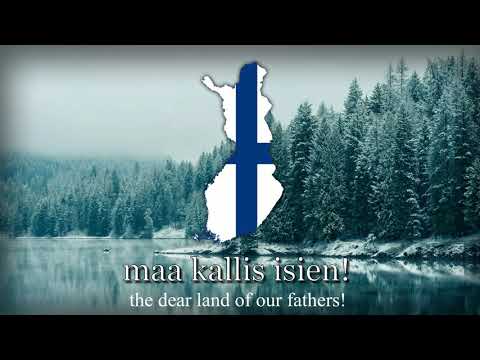
maa kallis isien!
Sun kukoistukses kuorestaan
kerrankin puhkeaa,
viel lempemme saa nousemaan
sun toivos, riemus loistossaan,
ja kerran, laulus synnyinmaa
korkeemman kaiun saa.
Translation
O our land, Finland, native land,
ring out, golden word!
No valley, no hill,
no water, no shore more beloved
than this northern homeland,
precious land of our fathers.
Your flowering from its bud
shall one day burst forth;
our love shall yet raise
your hope, your joy in their splendour,
and one day your song, native land,
shall gain a higher echo.
Interesting facts
Estonia
- 1. During the Soviet occupation the anthem was strictly forbidden and people were sent to Siberia for singing it, yet Estonians could still hear the melody every day: Finnish radio played Finland's anthem, set to the same tune, at the start and end of its broadcasts.
- 2. The Song Festival where the anthem was first sung, on 19 June 1869, is still held, usually every five years; the 1990 festival opened with about 30,000 singers on stage and some 100,000 people in the audience. In 2003 UNESCO proclaimed the Baltic song and dance celebrations a Masterpiece of the Oral and Intangible Heritage of Humanity.
- 3. The only legal act in which the anthem's text appears, and only in part, is Estonia's Independence Manifesto, published on 24 February 1918.
Finland
- 1. Originally written in Swedish, not Finnish. The Finnish words sung today, 'Maamme', are often credited to Paavo Cajander, who revised the translation in 1889, but the two stanzas in use come from an 1867 translation by a group of five poets that included Julius Krohn
- 2. Pacius's melody is also the tune of Estonia's national anthem, 'Mu isamaa, mu õnn ja rõõm', used from 1918 to 1940 and again since 1990, and of the Livonian anthem
- 3. Several composers set Runeberg's poem to music before Pacius, Runeberg himself among them, but Pacius's version was the first to become widely popular
- 4. No law makes it the national anthem, unlike Finland's flag and coat of arms: its status rests on long-established custom
Listen
Estonia

Finland