National Anthem Comparison
Indonesia vs Philippines
2
Shared themes
✗
Different moods
26
26 years apart
✓
Same continent
Indonesia
Indonesia Raya
Comparison Analysis
Indonesia and Philippines, both Asia nations, take distinct approaches to their national anthems. Indonesia's "Indonesia Raya" was written in 1924, while Philippines's "Chosen Land" dates to 1898.
Both anthems share themes of freedom and nature. Indonesia additionally explores unity, identity and hope, while Philippines also touches on love of homeland, flag and independence.
The emotional tones differ: Indonesia's anthem is majestic, while Philippines's is fierce.
Shared themes
Indonesia
🤝 Unity 🏛 Identity 🕊 Freedom 🌿 Nature 🌅 Hope
Philippines
❤ Love of homeland 🕊 Freedom 🚩 Flag 🌿 Nature 🗽 Independence
Shared themes:
🕊 Freedom 🌿 Nature
Metadata
| Indonesia | Philippines | |
|---|---|---|
| Written | 1924 | 1898 |
| Adopted | 1945 | 1898 |
| Lyricist | Wage Rudolf Supratman | Jose Palma |
| Composer | Wage Rudolf Supratman | Julian Felipe |
| Language | id | tl |
| Region | Southeast Asia | Southeast Asia |
Lyrics Side by Side
Indonesia
Indonesia Raya
Original
Indonesia tanah airku,
Tanah tumpah darahku,
Di sanalah aku berdiri,
Jadi pandu ibuku.
Indonesia kebangsaanku,
Bangsa dan tanah airku,
Marilah kita berseru,
Indonesia bersatu.
Hiduplah tanahku,
Hiduplah negeriku,
Bangsaku, Rakyatku, semuanya,
Bangunlah jiwanya,
Bangunlah badannya,
Untuk Indonesia Raya.
Indonesia Raya,
Merdeka, merdeka,
Tanahku, negeriku yang kucinta!
Indonesia Raya,
Merdeka, merdeka,
Hiduplah Indonesia Raya.
Translation
Indonesia, my homeland,
The land of my birth,
There it is that I stand,
To be a guide for my motherland.
Indonesia, my nationhood,
My people and my homeland,
Let us proclaim,
Indonesia united.
Long live my land, long live my country,
My nation, my people, all of them,
Awaken its soul, awaken its body,
For the Great Indonesia.
Great Indonesia,
Be free, be free,
My land, my country that I love!
Great Indonesia,
Be free, be free,
Long live the Great Indonesia.
Philippines
Lupang Hinirang
Original
Bayang magiliw,
Perlas ng Silanganan,
Alab ng puso
Sa dibdib mo'y buhay.
Lupang hinirang,
Duyan ka ng magiting,
Sa manlulupig
Di ka pasisiil.
Sa dagat at bundok,
Sa simoy at sa langit mong bughaw,
May dilag ang tula
At awit sa paglayang minamahal.
Ang kislap ng watawat mo'y
Tagumpay na nagniningning;
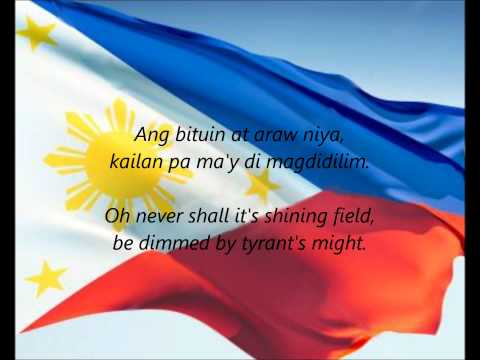
Ang bituin at araw niya,
Kailan pa ma'y di magdidilim.
Lupa ng araw, ng luwalhati't pagsinta,
Buhay ay langit sa piling mo;
Aming ligaya na pag may mang-aapi,
Ang mamatay ng dahil sa iyo.
Translation
Beloved land,
Pearl of the Orient,
The fire of the heart
In your bosom beats.
Chosen land,
Cradle of the brave,
To the conquerors
You shall never submit.
Through seas and mountains,
Through the wind and your blue sky,
There is splendour in the poem
And song of cherished freedom.
The sparkle of your banner
Shines with victory;
Its stars and sun
Shall never be dimmed.
Land of the sun, of glory and love,
Life is heaven in your embrace;
Our joy, when someone oppresses us,
Is to die for your sake.
Interesting facts
Indonesia
- 1. Wage Rudolf Supratman first performed Indonesia Raya on a violin at the 1928 Youth Congress, when he was twenty-five years old.
- 2. Supratman's printed lyrics and the first records sang "Mulia, mulia" ("glorious") in the refrain, but young nationalists sang "Merdeka, merdeka" ("free") instead, the words of today's anthem; questioned by Dutch police, Supratman showed his printed text to argue that "Merdeka" came from the public, not from him.
- 3. The full song has three stanzas. Government Regulation No. 44 of 1958 makes the first stanza, with its refrain sung twice, the usual sung form, and also sets out how all three stanzas are sung when the song is performed in full.
- 4. Supratman wrote both the words and the music; the familiar symphonic arrangement was created by the Dutch composer Jos Cleber in 1950 at the Indonesian government's request and tailored to President Sukarno's wishes.
- 5. After Supratman died in 1938 the rights passed to his heirs, his four sisters; once the song became the national anthem its copyright was treated as state property, with Supratman always named as its creator, and in 1959 his heirs formally handed the copyright to the government.
Philippines
- 1. The anthem was first performed in public, as a purely instrumental march, at the declaration of Philippine independence from Spain on June 12, 1898; Julian Felipe had played it on the piano for Emilio Aguinaldo and his lieutenants the day before
- 2. Its words have changed language: Palma's Spanish lyrics were translated into English in the 1920s by Camilo Osías and M. A. L. Lane, and the Filipino version sung today was proclaimed in 1956 and revised in 1962
- 3. Philippine law mandates that the anthem must be sung with fervor, and violations (like improper renditions) can result in fines or imprisonment
Listen
Indonesia

Philippines