National Anthem Comparison
Luxembourg vs Netherlands
2
Shared themes
✗
Different moods
292
292 years apart
✓
Same continent
Comparison Analysis
Luxembourg and Netherlands, both Europe nations, take distinct approaches to their national anthems. Luxembourg's "Our Homeland" was written in 1864, while Netherlands's "The William" dates to 1572.
Both anthems share themes of God / Faith and Freedom. Luxembourg additionally explores Nature and Love of homeland, while Netherlands also touches on Monarchy, Battle / War and Resilience.
The emotional tones differ: Luxembourg's anthem is Hopeful, while Netherlands's is Solemn.
Netherlands's anthem predates Luxembourg's by 292 years, having been written in 1572 compared to 1864.
Shared themes
Luxembourg
🌿 Nature ❤ Love of homeland ✝ God / Faith 🕊 Freedom
Netherlands
✝ God / Faith 👑 Monarchy 🕊 Freedom ⚔ Battle / War 💪 Resilience
Shared themes:
✝ God / Faith 🕊 Freedom
Metadata
| Luxembourg | Netherlands | |
|---|---|---|
| Written | 1864 | 1572 |
| Adopted | 1895 | 1932 |
| Lyricist | Michel Lentz | Unknown (attributed to Philips of Marnix) |
| Composer | Jean-Antoine Zinnen | Unknown |
| Language | lb | nl |
| Region | Western Europe | Western Europe |
Lyrics Side by Side
Luxembourg
Ons Heemecht
Original
Wou d'Uelzecht durech d'Wisen zéit,
Durech d'Fielsen d'Sauer brécht,
Wou d'Rief laanscht d'Musel dofteg bléit,
Den Himmel Wäin ons mécht:
Dat ass onst Land, fir dat mer géif
Heianzdo alles won,
Onst Heemechtsland, dat mir sou déif
An eisen Hierzer dron.
Onst Heemechtsland, dat mir sou déif
An eisen Hierzer dron.
O Du do uewen, deem séng Hand
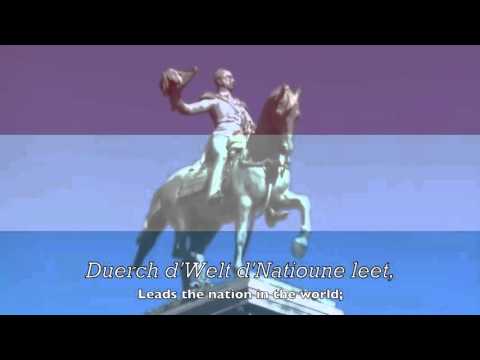
Durech d'Welt d'Natioune leet,
Behitt Du d'Lëtzebuerger Land
Vru friemem Joch a Leed.
Du hues ons all als Kanner schon
De fräie Geescht jo ginn,
Looss viru blénken d'Fräiheetssonn,
Déi mir sou laang gesinn!
Looss viru blénken d'Fräiheetssonn,
Déi mir sou laang gesinn!
Translation
Where the Alzette flows through the meadows,
Where the Sauer breaks through the rocks,
Where the vine blooms fragrantly along the Moselle,
The sky gives us wine:
That is our land, for which we would give
Everything today,
Our homeland, which we carry so deeply
In our hearts.
Our homeland, which we carry so deeply
In our hearts.
O You above, whose hand
Leads the nations through the world,
Protect the Luxembourgish land
From foreign yoke and sorrow.
You gave us all as children
The free spirit,
Let the sun of freedom keep shining,
Which we have seen for so long!
Let the sun of freedom keep shining,
Which we have seen for so long!
Netherlands
Het Wilhelmus
Original
Wilhelmus van Nassouwe
Ben ik, van Duitsen bloed,
Den vaderland getrouwe
Blijf ik tot in den dood.
Een Prinse van Oranje
Ben ik, vrij, onverveerd,
Den Koning van Hispanje
Heb ik altijd geëerd.
Mijn schild ende betrouwen
Zijt Gij, o God mijn Heer,
Op U zo wil ik bouwen,
Verlaat mij nimmermeer.
Dat ik doch vroom mag blijven,
Uw dienaar t'aller stond,
De tirannie verdrijven
Die mij mijn hart doorwondt.
Translation
William of Nassau
Am I, of German blood,
Faithful to the fatherland
I remain until death.
A Prince of Orange
Am I, free and fearless,
The King of Spain
I have always honoured.
My shield and my trust
Are You, O God my Lord,
On You I wish to build,
Never forsake me.
That I may remain devout,
Your servant at all times,
Driving out the tyranny
That wounds my heart.
Interesting facts
Luxembourg
- 1. One of the few anthems written in Luxembourgish, a language spoken by fewer than 400,000 people worldwide
- 2. The anthem is entirely about nature and homeland, with no references to war, rulers, or religion
- 3. Luxembourg also has a royal anthem, 'De Wilhelmus,' used for ceremonies involving the Grand Duke
Netherlands
- 1. The full anthem has 15 stanzas, but only the first and sixth are typically performed, making the complete version one of the longest anthems ever written.
- 2. The melody of Het Wilhelmus was likely adapted from a French Huguenot soldier's song called 'Chartres,' giving the Dutch anthem ironic French musical roots.
- 3. Despite being the world's oldest anthem text, it was only officially adopted by royal decree in 1932; for over 350 years it existed purely by tradition.
Listen
Luxembourg
Netherlands
